
Chris Kamara describes the battle with speech apraxia and the struggles within
Chris Kamara has described the general public’s reaction to his speech apraxia diagnosis as “wonderful”, but he says his doctors are unable to predict whether or not he will progress over time.
The 64-year-old former footballer and Sky Sports analyst appeared to blur words on the Soccer Saturday show the previous weekend, prompting viewers to message him on various social media platforms .
In a later tweet, he provided an explanation, saying he had a thyroid problem and also developed a speech impediment over time.
During an interview on Good Morning Britain, the former athlete expressed his gratitude to his family and friends for their support and mentioned that he was working with a speech therapist in an effort to find a solution to the problem.

Chris Kamara
Where is Chris Kamara going wrong with his speech?
Chris Kamara, a former football player who previously played for Leeds United and Bradford City, has revealed he has offered to quit his current program on ITV due to recent health issues. Chris recently revealed he has speech apraxia, which is why he is taking a sabbatical from Sky Sports and will be leaving the program on Saturday after spending more than 20 years there.
Kamara also revealed that he intended to quit his most recent ITV programme, The Games, but TV executives convinced him to stay in the role. During the first episode of the new season, Chris spoke about his choice to leave the program and thanked the folks at ITV for trying so hard to convince him to stay.
Along with seasoned commentator Simon Brotherton, he will work on this project. They worked together on BBC Radio 5 Live in the late 1990s when he was just starting out in the broadcasting industry.
Fans noticed Kamara slurring his words as he spoke on TV the previous month. Afterwards, Kamara explained that his neurological condition prevented him from speaking. Aphasia is characterized by difficulty in expressing oneself verbally and is caused by damage to the brain.
The disorder known as apraxia of speech affects Chris Kamara.
The NHS Speech and Language Pathology Department defines apraxia as “difficulty performing planned movements”. Apraxia is a neurological disorder. A person with apraxia may be able to perform unplanned movements, such as yawning, but they may not be able to perform planned movements, such as opening their lips when asked.
Chris Kamara, Soccer Saturday presenter and former football player, revealed in March that he suffered from ‘speech apraxia’ after viewers feared he appeared to stumble during an appearance on the show . Kamara is 64 years old.
The article goes on to state that speaking requires a complicated set of muscle movement patterns, and apraxia of speech is presumed to be caused by a malfunction in the part of the brain responsible for organizing these movements.
Chris Kamara, who has worked as a broadcaster for Sky Sports for 24 years, has announced he will leave the company at the end of the football season in 2021/22.
What happened to Chris Kamara according to his Twitter?
Following his appearance on Football on Saturday, the Sky Sports presenter was met with skepticism from viewers online due to it appearing he had mispronounced his words while being filmed.
He wanted a few of you who tweeted today to know that I’m fine, as Kamara explained in his post, and he just wanted to let you know. Speech aphasia is something I struggle with in addition to my thyroid issue, and I have been working to get it under control.
Some days it may be a little slower than usual, while other days it may be completely normal. I really hope I can win this! His initial tweet, which was tweeted on Saturday, March 19, has received over 160,000 likes, 2,500 retweets, and 500 quote tweets since it was tweeted.
Many people, including current and former athletes such as Viv Anderson, Steph Houghton and Robert Snodgrass, have offered Kamara their support and encouragement through social media.
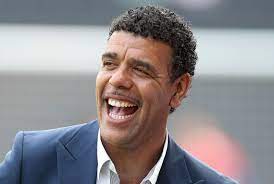
Chris Kamara
What is the speech disorder known as apraxia?
Aphasia is defined as “difficulty performing planned movements” by the National Health Service (NHS) Department of Speech and Language Therapy. It states that a person with apraxia may be able to perform involuntary movements, such as yawning, but may not be able to perform planned movements, such as opening the lips when we ask him.
He goes on to add that “speech involves a complicated set of muscle movement patterns”, and he also says that “apraxia of speech is thought to be caused by a malfunction in the area of the brain that is responsible for organization of these movements”.
He says that although the muscles are not weak, they will not function properly when a person strains to speak.
The inability to communicate effectively due to apraxia of speech can be quite trying. In most cases, the person is aware of the message they want to convey. It’s possible that when they try to say it, it comes out incorrectly or doesn’t come out at all. They might be able to pronounce a word perfectly at one point, but the next time they try, it might come out completely incorrectly.
“Most of the time, a person with apraxia will struggle to speak in everyday conversations. On the other hand, they may be good at ‘automatic’ speaking tasks like counting, swearing, repeating rhymes, hello and goodbye.
The degree of the disorder can vary the symptoms of speech apraxia, but here are some of the possible manifestations of the disease:
- Having trouble pronouncing words correctly
- Being able to say a word correctly one minute, but not the next
- Having more difficulty with the beginning of words
- Having more problems with longer words than with shorter words
- Being aware of one’s mistakes but often unable to correct them
- Speak more slowly
- Be better at “automatic” speech tasks, like counting and singing
What’s wrong with his thyroid?
In the past, when Kamara was experiencing what he called “brain fog,” he underwent a brain scan to determine whether or not he was beginning to acquire dementia.
However, his symptoms were explained by an underactive thyroid, for which he is currently receiving medication. He feared the illness was linked to heading the ball as a football player; however, it was discovered that this was not the case.
When a person’s thyroid gland does not generate the proper amount of hormones, this condition is known as hypothyroidism or underactive thyroid gland. can often be beneficial in the treatment of an underactive thyroid.
Here are some of the symptoms of hypothyroidism:
- Fatigue
- Weight gain
- The Depression
- Being sensitive to cold
- Dry skin and hair
- Muscle aches
A thyroid function test is the only way to detect whether or not a person has a thyroid condition. During this test, the person’s blood is analyzed to determine the levels of thyroid-stimulating hormone, thyroxine and triiodothyronine, as well as other thyroid hormones if necessary.
