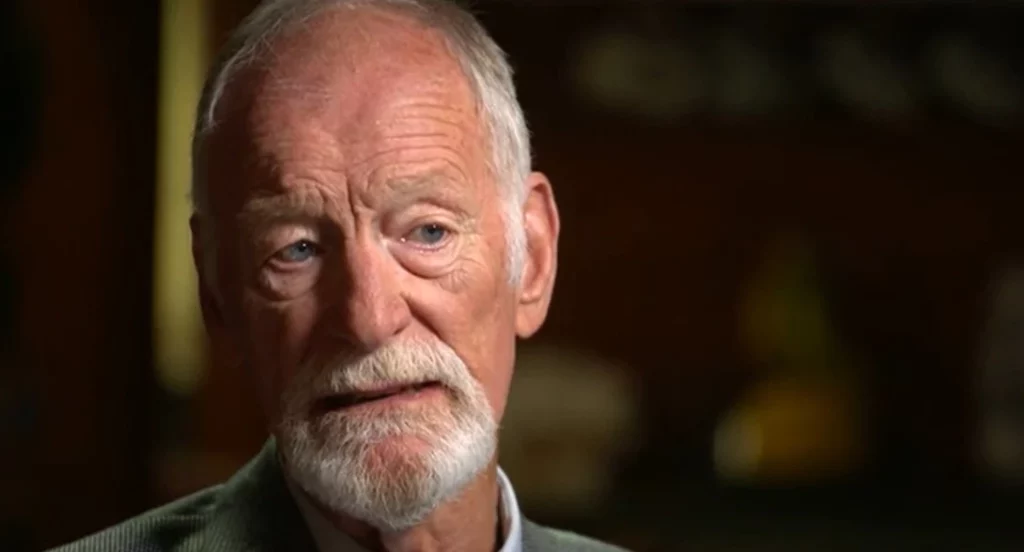
Where is the parole officer who was assigned to Charles Manson’s case, Roger Smith?
In 1969, the state of California was rocked by a series of murders that were, in retrospect, discovered to have been perpetrated by Charles Manson and his cult. Dateline: The Summer of Manson, which airs on NBC News, focuses on Charles Manson’s early life and how he amassed his following, which led to his subsequent murderous rampage. A conversation with Charles’ parole officer, Roger Smith, that took place before the murders is featured on the show. So, are we going to investigate him further to find out more about him?

Roger Smith
Who exactly is this Roger Smith?
Although Charles Manson was raised in a family that was both loving and godly, he never liked going to church, even as a child. According to the show, Charles lied to people, stole stuff, and was obsessed with blades. Charles also stole things. Ultimately, he was sent to a correctional facility after serving his first sentence in a juvenile detention center. It was around 1967 that Charles was finally released and Roger Smith served as his parole officer. Roger was at the time participating in an experimental program for parole officers. The purpose of the program was to explore how agents were influenced by different workloads.
Roger started with forty different situations, but towards the end he only had Charles to deal with. According to Tom O’Neill, who studied Charles and his life, Roger Smith was considered an authority on gangs, collective behavior, violence and narcotics in 1967. Manson, the one and only parolee he ever supervised, would continue to dominate the conduct of a gang as a whole through the use of violence and narcotics. The number of people who followed Charles grew over time, eventually leading to the nine deaths that occurred in July and August 1969 in four separate localities.
Roger said the following about Charles: “Charlie was the most antagonistic parolee I’ve ever met. He was completely upfront and honest about it. He informed me from the start that he had no way of meeting the conditions of his parole. It was impossible for him to avoid going back to the joint [jail], so there was no other option. He went on to say, “In another way, I think Charlie was really kind of bothered by it all – by the idea that people were nice and open and willing to do things with him.” When he first arrived in the Haight, the local ladies were more than happy to share their bed with him. They weren’t concerned that he might have only recently left the facility. It was quite a rude awakening for him.
Where is Roger Smith right now?
Ultimately, Charles and some of his followers were convicted for their role in the heinous murders and sentenced to long prison terms for their actions. Referring to the parole program Charles had previously been on, Roger said, “There’s a lot of Charlies going around, believe me.” “He is just one of hundreds of thousands of people who are released from prison after a terrible and heartbreaking experience, unprepared for anything but to return to the streets and do more of the same – only bigger. .”
Roger was a doctoral candidate at the University of California, Berkeley in the 1960s. He was interested in criminology and the etiology of crime at the time. For over 16 years, he has worked for various public and private organizations in Illinois and the San Francisco Bay Area as a research director, probation officer, and social worker. During his career, he held positions in different prison services dedicated to the treatment of sex offenders. Until 1987, Roger served as Director of the Correctional Treatment Program at the Oregon Department of Mental Health. He held this position for a total of nine years.
As a Program Specialist, Roger worked for the National Academy of Corrections and the United States Department of Justice in Boulder, Colorado for a two-year period. In Honolulu, Hawaii, he worked for the Department of Public Safety as the Director of Sex Offender Programs from the 1990s to 2002. He retired from this position in 2002. In addition to this, Roger has been during ten years director of the Michigan State Office of Forensic Mental Health Services. The retired criminologist has worked as a consultant in areas related to forensic and correctional mental health since the year 2002. Although Roger has lived and worked in a few different states, he currently lives in Redmond, Oregon at his home. .

Roger Smith
Charles Manson case update:
Manson had a terrible start to life that led to decades of crime as an adult
Charles Manson was born on November 12, 1934 in Ohio. His mother, Kathleen Maddox, was a teenager; Charles’ biological father abandoned her before the baby was born. She married William Manson shortly before the baby was born and soon began calling her son Charles Milles Manson, after her new husband.
Manson grew up with his mother’s loved ones in an allegedly neglectful and abusive environment. By the age of 13, he had begun committing various petty crimes, including robbery, and in 1949 he was detained at the Indiana Boys School, where he suffered assault and sexual abuse. During a period of several escape attempts and transfers to numerous juvenile centers, he began to commit violent sexual assaults on other boys and was eventually transferred to the Ohio Federal Reformatory in 1952.
When he was 19, in 1954, Manson was released to his aunt and uncle in McMechen, West Virginia, and for a brief period he appeared to settle down, marry, and move to Los Angeles. But Manson continued to commit crimes; in 1957 he was sentenced to three years in a Los Angeles prison, during which time his wife filed for divorce.
The spanning decade 1957 to 1967 was turbulent for Manson. He spent much of it in a cycle of suspended sentences, probation violations and jail time. He became a pimp, was briefly married to a sex worker, and began exploring ways to become famous in Hollywood. He took guitar lessons – although, according to a producer who would later try to work with him, he was an “absolute disaster” – paid close attention to the Beatles, developed ambitions to become a songwriter- interpreter and tried to establish privileged links with film studios.
During this time he carefully studied religion as a tool of control and manipulation – particularly Scientology – as well as social engineering. He also sought the advice of other career criminals, including pimps who taught him techniques to successfully coerce and break down the resistance of the women under his control.
But Manson exploited the drug-free and happy goodwill of the era, bonding with his would-be supporters and then luring them into unbalanced and manipulative relationships. He quickly targeted his first follower, 23-year-old Mary Brunner, for her home and income. Brunner, who had moved to California to work as a librarian, easily turned to petty crime and supported Manson while he recruited supporters.
Manson relied on this cover. He traveled throughout California, approaching young women in Golden Gate Park in San Francisco as well as Venice Beach in Los Angeles, presenting himself as a religious figure and urging them to follow him in completely surrendering their identity to him. His following grew, and in the fall of 1967, Manson packed up the family and moved them to Los Angeles — to his dreams of Hollywood stardom.
