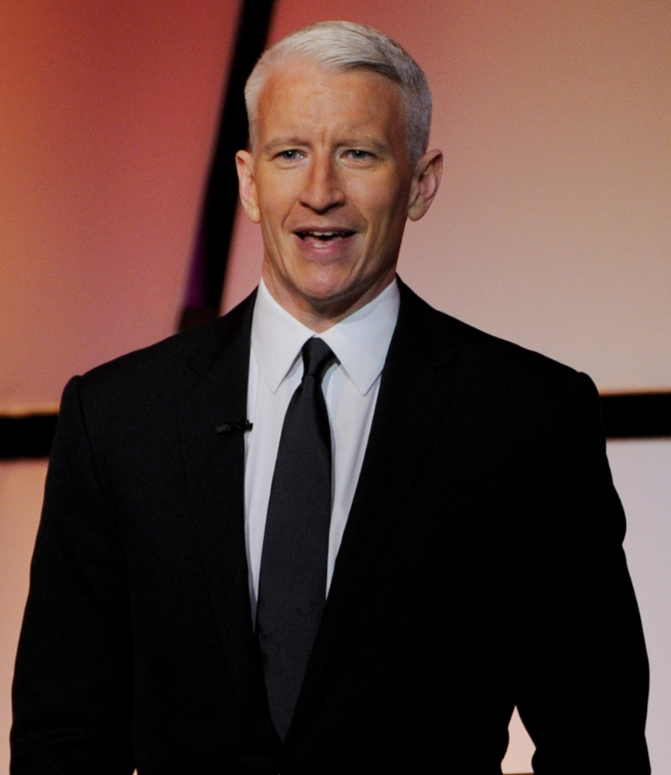
The host of CNN Anderson 360 is famed journalist and political pundit Anderson Cooper. Cooper anchors the 60 Minutes program on CBS News in addition to his work for CNN.
Cooper began working for CNN in 2001, and in 2003 he was given his own program, Anderson Cooper 360°, which he has hosted ever since.
For his on-the-ground coverage of key news events he became famous, and his reporting on Hurricane Katrina greatly increased his notoriety.
Cooper received the highest award given by the Haitian government for his coverage of the 2010 earthquake in Haiti. Anderson Live, a syndicated daytime chat show he also hosted, aired from September 2011 to May 2013.
AndersonCooper
Is Anderson Cooper leaving CNN? Where is he now?
Anderson Cooper won’t be leaving CNN, sorry. After his recent hiatus from the show, viewers of the news channel assumed so, but it appears he simply took time off.
He currently has no plans to leave CNN. He will take a short break and then get back to work. Anderson is one of the people who has worked for CNN since 2001.
Anderson 360, which he has hosted for 21 years with the same enthusiasm, was entrusted to him as soon as he joined the channel.
Cooper also mentions that he works for CNN and 60 Minutes in his Twitter bio. Since May 29, he hasn’t tweeted anything. Anderson currently spends his free time with his family.
Isn’t Anderson Cooper on the air tonight?
The August 20 CNN show appears to have Anderson Cooper tonight. But he had already said in February that he would take a break from the program because he had just had his second child.
In order to spend more time with his newborn, Anderson had said he would take two weeks off.
On February 11, he made a live television announcement about the birth of his son. He said he and his ex-partner Benjamin Maisani will be raising their new baby.
He divulged personal details about himself in an unrestrained 6-minute video, and in the second half of the video he announced that he would be unavailable for work for two weeks.
There’s no doubt that Anderson has started appearing frequently on his show and has yet to make the decision to leave CNN.
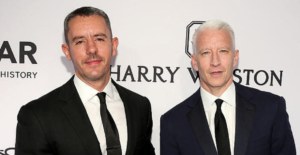
Anderson with his former partner Benjamin
Anderson Cooper broke up with partner Benjamin Maisani: relationship update
2018 saw the breakup of Anderson Cooper and Benjamin Maisani. Their relationship dated back more than ten years.
They started dating in 2009, but didn’t go public with their relationship until 2015. Cooper traveled to Dallas at least five times to hang out with Dr. Victor Lopez before they called it quits. .
The couple, despite the divorce, are still close and raising their newborn baby together. Cooper announced in February that his ex-partner would share parenting responsibilities for their two children.
He made it known on his show that Benjamin was his best friend, that Wyatt was being adopted, and that his last name would be changed to Maisani-Cooper.
Anderson Cooper Bio
American television journalist and political commentator Anderson Hays Cooper, a member of the Vanderbilt family, was born June 3, 1967. He is the main show anchor of the CNN Anderson Cooper 360° news program. Cooper works for CNN as well as CBS News’ 60 Minutes as a correspondent. He began traveling the world and filming war-torn areas for Channel One News in 1989, the year he graduated from Yale University with a Bachelor of Arts. Cooper joined ABC News in 1995 as a correspondent, but he soon took on other positions on the network, briefly serving as co-anchor, host of a reality game program, and back-up for a host of morning talk show.
Cooper joined CNN in 2001, and in 2003 he was given his own program, Anderson Cooper 360°, which he has hosted ever since. He gained a reputation for covering news events live from the stage, and his popularity skyrocketed after covering Hurricane Katrina. Cooper was awarded the National Order of Honor and Merit, the highest honor bestowed by the Haitian government, for his coverage of the 2010 Haiti earthquake. He also hosted his own syndicated daytime talk show, Anderson Live, from September 2011 to May 2013.
Cooper received an Edward Murrow Award from the Overseas Press Club in 2011 in addition to 18 Emmy Awards, two Peabody Awards and other accolades. He came out as gay in 2012, according to the New York Times, and at the time was “the most renowned openly gay reporter on American television.” Cooper has won numerous accolades from LGBT rights group GLAAD and made history in 2016 when he chaired the first openly LGBT presidential debate.
| Born |
Anderson HaysCooper June 3, 1967 New York, United States |
|---|---|
| foster mother | Yale University (BA) |
| Occupation | Broadcast journalist, political commentator |
| active years | 1990-present |
| Employer |
|
| Television |
|
| Children | 2 |
| Parents) |
|
| Relatives | Vanderbilt Family |
Early life and education
Cooper, the youngest son of Wyatt Emory Cooper and Gloria Vanderbilt, an artist, was born in Manhattan, New York. Reginald Claypoole Vanderbilt, a millionaire horseman in the Vanderbilt family, and socialite Gloria Morgan Vanderbilt were his maternal grandparents. Reginald’s patrilineal great-grandfather was businessman Cornelius Vanderbilt, who established Vanderbilt’s illustrious shipping and railroad fortune. He is a great-great-grandson of Major General Hugh Judson Kilpatrick and his Chilean wife, Luisa Fernandez de Valdivieso, who accompanied General William Tecumseh Sherman on his march through Georgia. He is a second cousin once removed of screenwriter James Vanderbilt through his maternal line.
Cooper has a long history in the media. He was captured by Diane Arbus as a baby for Harper’s Bazaar. On September 17, 1970, the then three-year-old Cooper appeared as a guest on The Tonight Show alongside his mother. [Reference needed] He made an impostor appearance on To Tell the Truth when he was nine years old. Cooper modeled with Ford Models for Ralph Lauren, Calvin Klein and Macy’s from age 10 to 13.
Wyatt, who was undergoing open-heart surgery, had a series of heart attacks and died on January 5, 1978, at the age of 50. would have wanted me to go about my life and the decisions he would have wanted me to make,” according to Cooper. So I feel a strong bond with him.
At age 23, Carter Vanderbilt Cooper, Cooper’s older brother, committed suicide by jumping from the 14th-floor terrace of Vanderbilt’s penthouse residence in New York City. Cooper was 21 at the time. In a later essay on her son’s death, Gloria Vanderbilt expressed her opinion that the suicide was caused by a psychotic episode brought on by an allergy to salbutamol, a prescription asthma drug. Anderson became interested in journalism after Carter’s suicide.
Career
At the beginning of his career
Cooper majored in political science at the University of Virginia, where he spent two summers working as an intern at the Central Intelligence Agency (CIA). He sought a career in journalism despite not having a college degree in journalism. By his own admission, he was an avid consumer of news even when he was still in the womb. After completing his first correspondence job in the early 1990s, he took a vacation and moved to Vietnam, where he stayed for an entire year. During this time, he attended Vietnam National University in Hanoi to study Vietnamese language.
First channel
After graduating from Yale, Cooper tried unsuccessfully to secure an entry-level position with ABC answering phones, but was unsuccessful. Cooper, who was struggling to break into on-air reporting, made the decision to craft a press pass with the help of a buddy in order to gain access to more events. Cooper was then working as a fact checker for the small news agency Channel One. Channel One is responsible for producing a news program aimed at young people that is broadcast to a large number of middle and high schools across the United States. [13] After that, Cooper entered Myanmar alone using the fake press pass and he encountered students who were fighting the Burmese government. [11] At the end of the day, he managed to sell his new house to Channel One.
After completing his reporting in Myanmar, Cooper moved to Vietnam for a year to take classes at Hanoi University and study the Vietnamese language. Cooper soon began shooting and compiling reports on Vietnamese life and culture for Channel One when he was able to convince Channel One to let him take a Hi8 camera with him. These reports were broadcast on Channel One. In 1992, he resumed filming stories of war-torn countries all over the world, such as Somalia, Bosnia and Rwanda, among others.
In 1994, after performing such missions for several years, Cooper realized that he had gradually hardened to the violence he witnessed all around him; the atrocities of the Rwandan genocide were insignificant to him. When I saw twelve corpses, my first thought was, “Well, there are only twelve; it can’t be that awful. However, one particular event was the catalyst that shook him.
